
Article Directory
A tent manufacturer once called us about a client who wanted a long-term construction-site shelter. Two suppliers had quoted different directions: one offered polyester tent fabric with a PU coating, the other a PVC-coated polyester composite. Both were waterproof, both came from legitimate factories, and both were priced differently. The buyer got stuck because the comparison was made at the wrong level. The short conclusion is this: PVC tent fabric is the more reliable choice for shelters that stay in service through months of weather, while polyester tent fabric is the better option when a tent is carried and pitched frequently. The rest of this article explains why, using the same specification-level criteria that procurement teams and product engineers use when they select materials.
What Is PVC Tent Fabric?
PVC tent fabric is a composite material: a woven polyester base cloth with a layer of plasticized polyvinyl chloride coated or laminated onto one or both sides. The polyester scrim carries the mechanical load, while the PVC layer supplies waterproofing, airtightness, abrasion resistance, color, and a surface that can be joined with heat welding. Because the PVC compound can be formulated with UV stabilizers, flame retardants, plasticizers and pigments, the finished material is a combination of weaving technology and polymer compounding.
In practice, PVC tent fabric is specified by three numbers: yarn denier, thread count, and finished grammage. The range is wider than many specifiers expect. A light 300D x 500D construction at 9 x 9 threads per 10 cm produces a 380-500 gsm fabric for portable awnings, market stalls and quick-pitch shelters, a category that includes the lightweight 300x500D PVC tent tarpaulin. Mid-range fabrics such as 1000D x 1000D at 20 x 20 threads fall in the 610-650 gsm band and balance strength with cutting and welding behavior. At the top end, 1300D x 1300D camouflage constructions reach 1050 gsm and are built for military tents, field hospitals and extreme-climate shelters.
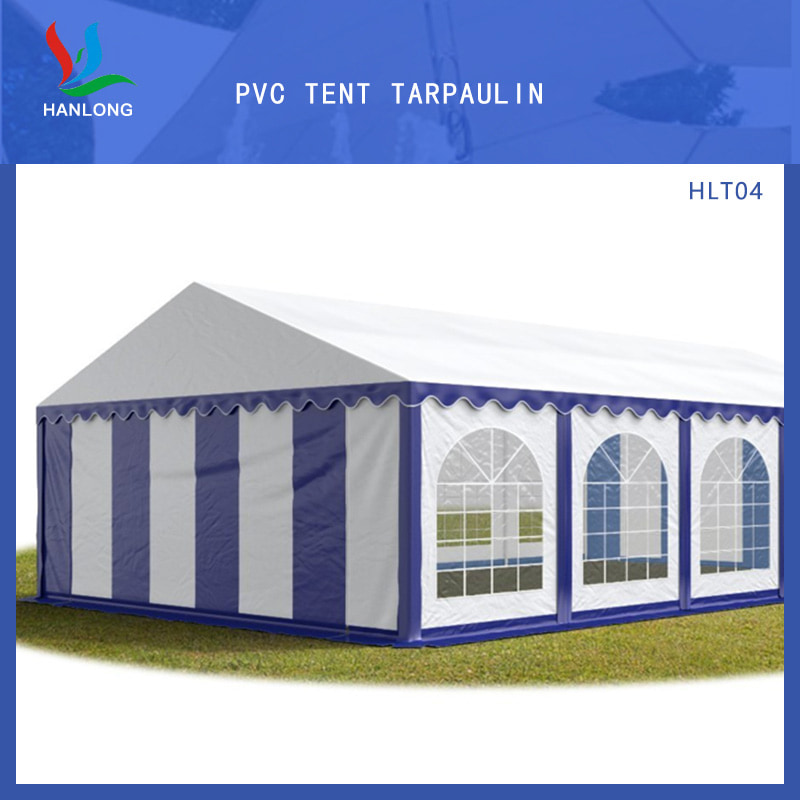 Custom 300X500D 9X9 380G/500G PVC Tent Tarpaulin Fabric Suppliers, Company - ZheJiang Hanlong New Material Co.,Ltd is China 300X500D 9X9 380G/500G PVC Tent Tarpaulin Fabric suppliers and OEM company, Item HLT04...View Product →
This spread matters because the term "PVC fabric" by itself is not a performance claim. A 380 gsm PVC tent fabric and a 1050 gsm PVC tent fabric behave very differently under wind load, snow load and repeated handling. When comparing PVC to polyester, the comparison should always be between specific constructions, not between two generic names.
What Is Polyester Tent Fabric?
In the camping and outdoor sector, polyester tent fabric usually means a woven polyester textile with a water-repellent finish or a thin polyurethane (PU) or silicone coating on the inner or outer surface. This is not a fully coated composite. The polyester yarn provides strength and dimensional stability, while the coating or finish prevents rain from soaking through the weave. The result is a fabric that folds into a small volume, weighs far less than a PVC composite of comparable size, and costs less per meter.
Typical finished weights for polyester tent fabric run from about 150 gsm for ultralight trekking tents to roughly 350-400 gsm for large family tents. Seams are sewn and then sealed with tape. This construction is suited to tents that are used for days or weeks at a time, then packed and moved to the next site, and not expected to survive months of permanent exposure.
The trade-off is direct. Polyester tent fabric saves weight and money, but it loses on long-term weather resistance, weldability, and resistance to abrasion and puncture. For a backpacking shelter, that is the right trade. For a permanent camp or a shelter that must stay up for a whole season, it is usually not.
Key Differences at a Glance
The table below summarizes the two material families at the level where purchasing decisions are made.
| Criteria | PVC Tent Fabric | Polyester Tent Fabric |
|---|---|---|
| Base construction | Polyester scrim with PVC coating or lamination | Polyester weave with PU/silicone coating or repellent finish |
| Typical finished weight | 380-1050 gsm | 150-400 gsm |
| Waterproofing | PVC layer is inherently waterproof | Depends on coating quality; taped seams required |
| Tear strength | High, especially above 600 gsm | Moderate; varies with yarn denier and weave |
| UV resistance | Good when UV stabilizers are added | Varies; thin coatings erode over time |
| Seam method | High-frequency heat welding | Sewing plus seam tape |
| Portability | Heavy for the same covered area | Light and compact |
| Unit cost | Higher per square meter | Lower per square meter |
| Service life outdoors | Often longer with UV-stabilized formulation | Usually shorter under permanent exposure |
| Typical applications | Industrial shelters, military tents, disaster relief, large marquees | Camping tents, trekking tents, pop-up shelters |
The table is simplified on purpose. A heavy polyester tent fabric can weigh more than a light PVC tent fabric, and quality varies strongly within both families. The general patterns for weight, seam method and lifetime nevertheless hold across almost every product in these two groups.
Performance Comparison by Use Case
Weight and Packability
At the same covered area, PVC tent fabric typically weighs 1.5 to 3 times as much as polyester tent fabric, because the PVC layer adds mass on top of the base cloth. When a shelter is carried by hand, packed repeatedly, or moved between sites, polyester is the obvious choice. When the tent is transported to a fixed location by vehicle or trailer and then stays there, weight matters far less than durability, and the heavier PVC construction stops being a disadvantage.
Tear Strength and Abrasion Resistance
PVC tent fabric wins clearly on tear strength and puncture resistance. A 1000D PVC construction benefits from both a heavy base yarn and a continuous polymer layer that distributes local stress over a wider area. That is why heavy specifications such as the 1050 gsm camouflage PVC tent fabric are selected for military shelters and emergency field units: the material keeps its integrity under wind load, sand and rough handling. The relationship between yarn construction and ultimate performance is covered in more detail in our analysis of tear resistance in PVC tent fabric.
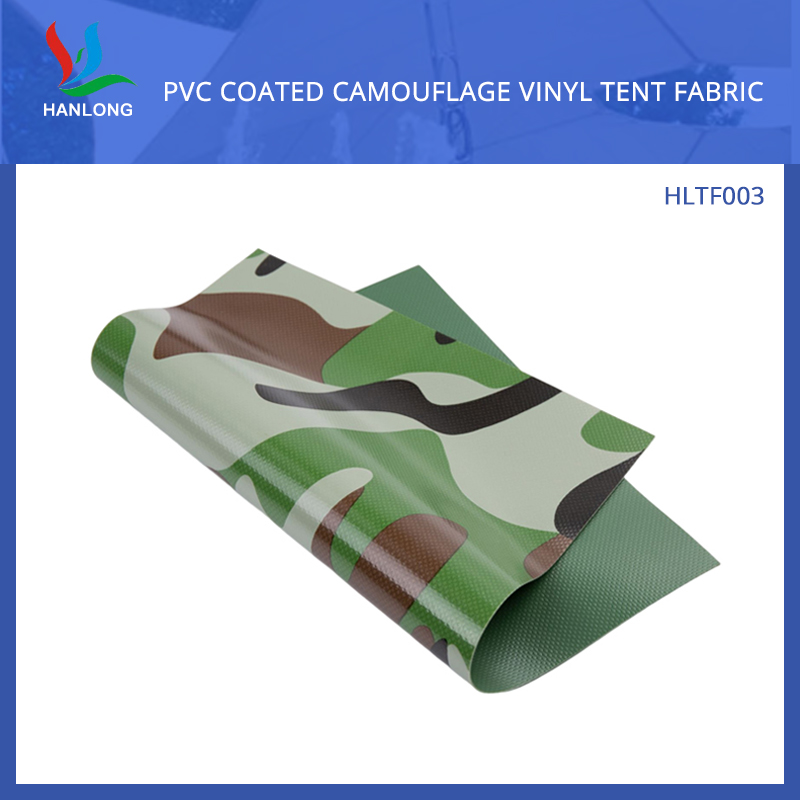 Custom PVC Coated Camouflage Vinyl Tent fabric 1300DX1300D 20X20 1050GSM SuppliZheJiang Hanlong New Material Co.,Ltd is China PVC Coated Camouflage Vinyl Tent fabric 1300DX1300D 20X20 1050GSM suppliers and OEM compa...View Product →
Waterproofing and Seam Reliability
Waterproofing is where the two families diverge most. On a polyester tent, waterproofing depends on coating quality and on sewn seams that must be taped carefully; any stitching without proper sealing becomes a wet point. On a PVC tent, the polymer layer is inherently waterproof, and seams are generally joined with high-frequency heat welding, which fuses two PVC surfaces into one continuous membrane. A welded PVC seam needs no separate sealant, which is why industrial tents and military shelters rarely carry a separate rainfly. For installations that remain outdoors for a long period, this is also why PVC tent fabric remains the preferred material for weather-resistant shelters.
UV Resistance and Temperature Behaviour
Both materials are polyester-based beneath the surface, and polyester yarn is sensitive to ultraviolet light. In polyester tent fabric, the protective layer is thin; after a season or two of strong sun, the coating erodes and the yarn begins to degrade. In PVC tent fabric, the polymer layer is thick enough to carry UV stabilizers and opaque pigments that shield the scrim below. The trade-off appears at extreme temperatures. PVC becomes stiffer in cold and softer in heat, so a serious PVC tent fabric uses plasticizers designed for the intended climate. The specification should always state a cold crack temperature: a fabric rated for -20°C is not the same product as one rated for -40°C, even when the visual appearance is identical.
Cost per Square Meter vs Cost per Year
The most common procurement mistake is to compare only unit prices. A 610 gsm PVC tent fabric costs more per square meter than a 190 gsm polyester fabric, and a buyer who stops at that comparison will make the wrong choice. The correct comparison is cost per year of service. A polyester tent made for summer camping is not intended to stand for twelve months under UV load. A PVC tent tarpaulin, selected at the right grammage and film formulation, routinely remains functional for several years in permanent outdoor exposure. For short-term and portable use, polyester is cheaper per season. For long-term fixed installations, PVC usually wins on lifetime cost.
How to Choose: A Practical Framework
Three questions come first: How long will the shelter stay in one place? How often will it be packed and moved? What loads will it face, such as wind, snow, sand, chemical exposure or heavy user traffic? The answers lead to one material family or the other.
Choose polyester tent fabric when:
- The tent is carried or stored repeatedly and pack size is important.
- The shelter is used for days or weeks rather than months or years.
- User-side seam taping and maintenance can be managed on site.
- Upfront budget is tight and the expected service life is under two seasons.
Choose PVC tent fabric when:
- The shelter stays in place for months, seasons or years.
- Wind, snow and impact loads are expected, not just rain.
- Welded seams and airtightness are required for a controlled interior environment.
- Flame-retardant or UV-stabilized performance must be documented.
For frame tents, marquees and mobile workshops that remain on site for a season, a mid-range specification is the most practical starting point. The 610-650 gsm 1000D PVC tent tarpaulin is the most requested construction in this category because it handles wind load without becoming difficult to cut, sew or weld. Above this weight, the main gain is puncture resistance. Below it, the main gain is easier handling and lower unit cost.
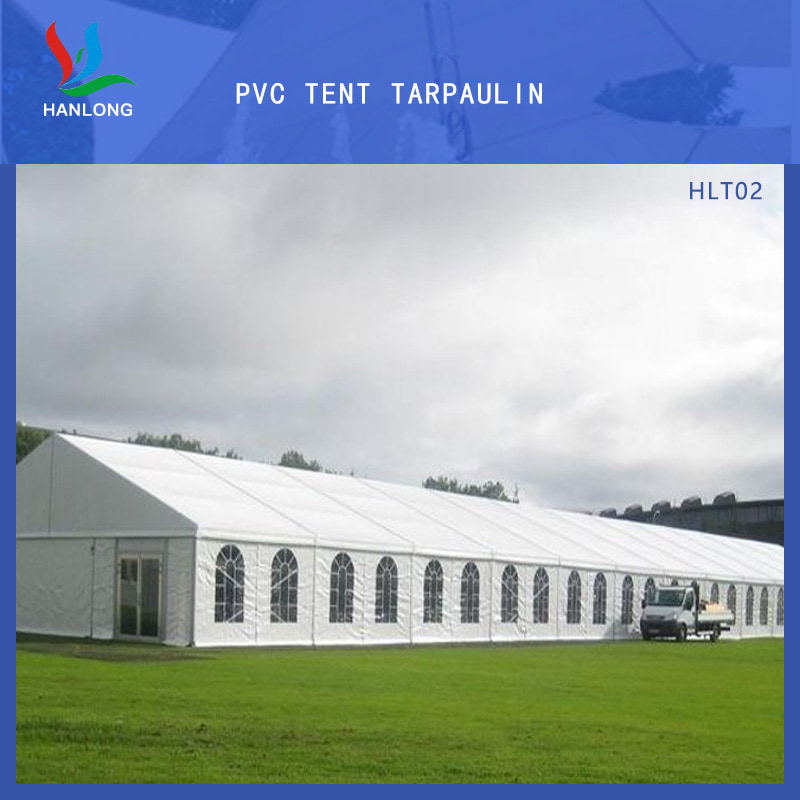 Custom 1000D 20X20 610G 650G PVC Tent Tarpaulin Suppliers, Company - ZheJiang HaZheJiang Hanlong New Material Co.,Ltd is China 1000D 20X20 610G 650G PVC Tent Tarpaulin suppliers and OEM company, Item HLT02 Weight (GS...View Product →
Supplier Considerations for PVC Tent Fabric
Once PVC is the chosen direction, the specification sheet becomes the contract. A few numbers deserve special attention:
- Base fabric yarn and density. A 1000D x 1000D fabric at 20 x 20 threads per 10 cm is not the same product as a 1000D fabric at 9 x 9 threads, even when the visual appearance looks similar.
- Finished grammage and its tolerance. A rated 610 gsm with a +/-5% tolerance delivers different performance and pricing from one with +/-8%.
- Coating formulation. Confirm whether UV stabilizers, flame retardants and cold-flex plasticizers are part of the compound, or whether they are offered as optional upgrades.
- Cold crack temperature. For winter use, the PVC layer must stay flexible at the minimum site temperature. There is a real difference between a -20°C grade and a -40°C grade.
- Weldability. Ask for welded seam samples before production. Heat-welding conditions vary between formulations, and a fabric that welds well in one factory may behave differently elsewhere.
These checks separate an engineered material from a commodity tarpaulin. A supplier that cannot provide this information usually cannot guarantee the performance either. For more detail on what to inspect before ordering, see our guide on how to judge coated tarpaulin quality.
Final Recommendation
Choose the material based on the mission profile, not the label. Polyester tent fabric serves the portable, short-term and budget-sensitive side of the market. PVC tent fabric serves the field where shelters must survive a rainy season, a winter, or a multi-year project. If your tent stays on site, faces wind and weather, and needs reliable welded seams, then PVC is the answer, provided that yarn, grammage and coating formulation are matched to the real conditions.
The last practical step is simple: ask for samples of both constructions, test the seam with a high-frequency welder, and put the numbers side by side. That direct comparison usually settles the debate faster than another datasheet.



 Home
