
Article Directory
- 1 Start with a Complete Specification, Not Just a GSM Number
- 2 Polyester Base Cloth: The Backbone of the Tent Fabric
- 3 Coating Type, Formulation, and GSM Tolerance
- 4 Performance Tests That Matter for Tent Fabric
- 5 Visual Quality, Color, and Roll Consistency
- 6 Customization and the OEM Development Process
- 7 Qualifying a Manufacturing Partner: What to Verify
- 8 Final Steps: From Specification to Field Performance
A request that reads “need PVC tent fabric, 650 gsm, waterproof” is one of the most common, and least actionable, inquiries an OEM supplier receives. A total fabric weight alone does not define performance, and “waterproof” is a result, not a specification. What actually determines cost and behavior is how those 650 grams are built: the polyester base cloth, the coating formulation, the additives, and the tolerances the factory is expected to hold.
This guide walks through the decisions that matter when sourcing OEM PVC coated tent fabric, from writing a complete specification sheet to interpreting test reports and qualifying a manufacturing partner. If you take only one idea away, it is this: you are not buying a roll of waterproof material; you are buying a defined set of mechanical, chemical, and visual properties. The clearer your definition, the fewer surprises you will have between sample approval and production.
Start with a Complete Specification, Not Just a GSM Number
Fabric weight is a useful summary, but it hides the variables that control strength, flex life, welding behavior, and flame resistance. Two tent fabrics can both weigh 650 gsm and perform completely differently in the field because one uses a heavier base cloth with a thinner coating and the other uses a lighter base cloth with a heavy topcoat.
Send the following information when you request an OEM quote:
- Finished fabric weight in grams per square meter (gsm) and acceptable tolerance
- Base cloth yarn count, for example 500D × 500D or 1000D × 1000D
- Weave density, usually expressed as ends × picks per inch
- Coating type: PVC coated or PVC laminated
- Surface finish: glossy, matte, embossed, anti-slip, or printed
- Mechanical requirements: tensile strength, tear strength, and adhesion
- Flame retardancy standard if required by your market
- UV stabilization level based on expected outdoor life
- Color reference and acceptable batch-to-batch color difference
- Welding method: high-frequency, hot-air, or both
This level of detail does not slow the process down; it speeds it up. Factories that manufacture from complete specifications can quote accurately, offer realistic lead times, and build samples that actually match production quality.
Polyester Base Cloth: The Backbone of the Tent Fabric
Nearly all PVC tent fabric sold today is built on a woven polyester base cloth. Polyester offers a strong combination of tensile strength, dimensional stability, and resistance to rot and moisture. The base cloth is not just a carrier for the PVC coating; it provides the structural performance that keeps the tent standing in wind and snow loads.
Yarn Denier and Weave Density
Yarn denier describes the linear density of the polyester yarn. Higher denier yarns normally provide higher tenacity and better resistance to impact and tearing. But higher denier is not automatically the right choice. A 500D × 500D base cloth with a dense 28 × 28 weave can feel very different from a 500D × 500D cloth with an open 9 × 9 weave, even though both are described using the same yarn count.
Weave density matters because the PVC coating must penetrate and anchor into the weave to build a strong bond. An over-open weave can allow excess coating to strike through, wasting material and producing a stiff, heavy hand. An over-dense weave can make coating penetration harder and increase the risk of adhesion failure. For most tent applications, manufacturers balance the weave between 10 × 10 and 30 × 30 threads per inch depending on the target weight and use case.
Base Cloth Weight vs. Coated Weight
One frequent misunderstanding is conflating base cloth weight with finished fabric weight. The base cloth is the dry polyester fabric before coating. In a 650 gsm finished PVC tent fabric, a typical base cloth might weigh 200–300 gsm, with the balance being PVC coating and additives. That ratio controls panel stiffness, packability, weldability, and price.
When you receive a sample, ask the supplier to state both the base cloth weight and the finished weight. A supplier that cannot separate the two may not be fully controlling the production process. For a proven reference grade used in frame tents and large shelters, our 610–650 g/m² PVC tent tarpaulin on a 1000D × 1000D base cloth represents a common specification that has been field-validated across many projects.
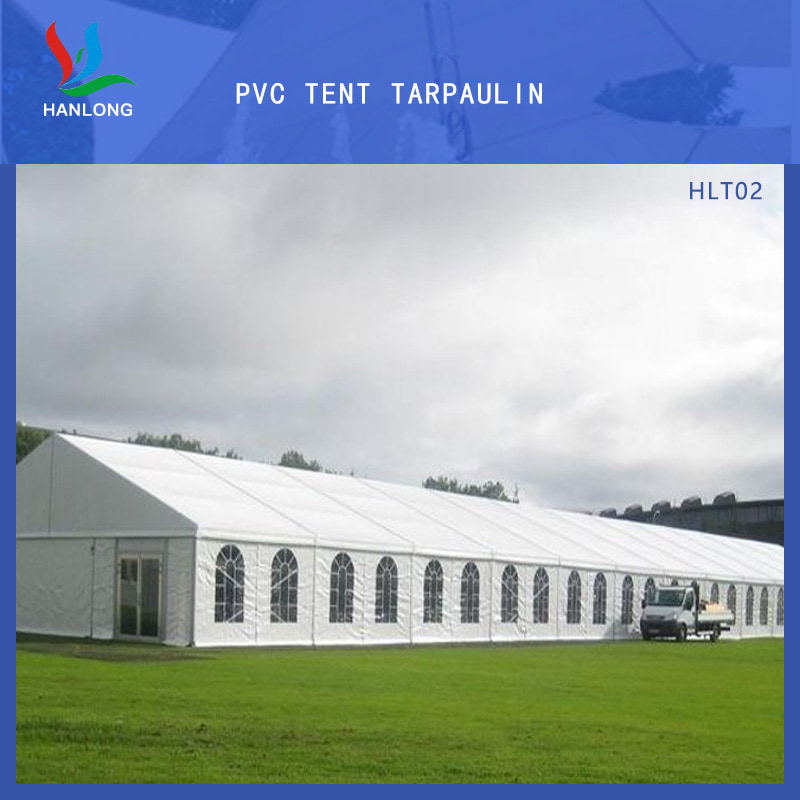 Custom 1000D 20X20 610G 650G PVC Tent Tarpaulin Suppliers, Company - ZheJiang HaZheJiang Hanlong New Material Co.,Ltd is China 1000D 20X20 610G 650G PVC Tent Tarpaulin suppliers and OEM company, Item HLT02 Weight (GS...View Product →
As a general guide, here is how base cloth ranges map to typical tent applications:
| Base Cloth Range | Typical Finished Weight | Common Tent Applications |
|---|---|---|
| 300D–500D | 380–500 gsm | Light camping tents, canopy tops, temporary shelters |
| 500D–840D | 500–700 gsm | Pop-up tents, gazebos, medium-duty event structures |
| 1000D | 600–850 gsm | Frame tents, warehouse shelters, large marquees |
| 1300D and above | 900–1100 gsm | Military tents, extreme weather structures, long-term installations |
Coating Type, Formulation, and GSM Tolerance
The PVC layer is where waterproofing, flame resistance, UV protection, and welding performance are actually delivered. This is also the stage where an OEM buyer should ask deeper questions about formulation and production control.
Coated vs. Laminated Construction
PVC coated fabric is produced by applying a PVC paste or plastisol directly to the polyester base cloth and then fusing it in heated ovens. The coating penetrates the interstices of the weave, creating one integrated material. PVC laminated fabric, by contrast, bonds a pre-made PVC film to the base cloth using heat and pressure. Coated fabrics tend to be preferred for tent applications that require good flexibility, cold resistance, and consistent weldability. Laminated structures are often selected when a very specific surface film is needed, such as a patterned or textured layer.
The distinction matters because the two routes have different failure modes. A coated fabric generally fails by surface wear or flex cracking, while a laminated fabric can fail by delamination at the film-to-cloth interface. When specifying, write “PVC coated” or “PVC laminated” explicitly instead of assuming the factory will pick the right one.
Additives That Change Real Performance
All PVC coatings contain plasticizers to keep the material flexible. The type and amount of plasticizer directly affect low-temperature behavior. A coating formulated for average outdoor use may stiffen and crack in colder climates, while a low-temperature plasticizer system stays pliable well below freezing. Flame retardants are another key part of the formulation; they are not measured by coating thickness alone. A thick coating without the correct flame retardant package can still fail a vertical burn test.
UV stabilizers protect both the PVC plasticizer system and the color from degradation. If the tent is intended to be continuously exposed to strong sunlight, specify a higher UV stabilization level instead of relying on appearance alone. Additives also include anti-mold agents, water repellency enhancers, and pigments. The right combination is what separates a tent fabric that lasts three seasons from one that lasts ten.
GSM Tolerance and Roll-to-Roll Consistency
Finished fabric weight is the most visible quality characteristic, but it cannot be judged by weighing a small hand sample alone. Consistent gsm across the roll width and along the roll length is what allows downstream cutting, welding, and sewing to run smoothly. In our production, we hold finished weight to a practical tolerance band that allows the material to behave consistently under hot-air and high-frequency welding. If you want to understand how the tolerance is measured and what a realistic range looks like, GSM tolerance and measurement practices explain the practical side of this inspection step.
Performance Tests That Matter for Tent Fabric
Laboratory testing is not a formality; it is the most reliable way to compare two fabric options before you make a large purchase. Start by requesting the following standards and typical reference values from your supplier:
| Test Property | Common Standard / Method | Why It Matters |
|---|---|---|
| Tensile strength | ISO 13934-1 | Measures how much load the fabric can carry before tearing |
| Tear strength | ISO 4674 or trapezoid method | Indicates how resistant the fabric is to cut propagation |
| Coating adhesion / peel strength | ISO 2411 | Checks whether the PVC layer stays bonded to the base cloth |
| Flame retardancy | EN 14115, BS 5438, or customer standard | Confirms the additive package meets your market requirements |
| UV aging | Accelerated weathering, e.g. ISO 4892 | Predicts strength reduction and color change after sun exposure |
| Weldability | High-frequency / hot-air welding trials | Verifies that seams hold consistently in production |
Pay special attention to adhesion strength. Poor adhesion between the PVC layer and the polyester base cloth leads to delamination at welded seams and folded edges, even if the initial tensile test looks fine. Also be cautious of a single high tensile number; it can be achieved by adding more coating weight, which reduces packability and makes the fabric stiffer. A balanced set of properties is the actual goal.
For the lighter end of the tent spectrum, where foldability and handling ease are priorities, the lighter 500D × 500D tent tarpaulin grade with a high 28 × 28 pick count shows how a different construction can deliver a different stiffness-to-strength balance for the same approximate application.
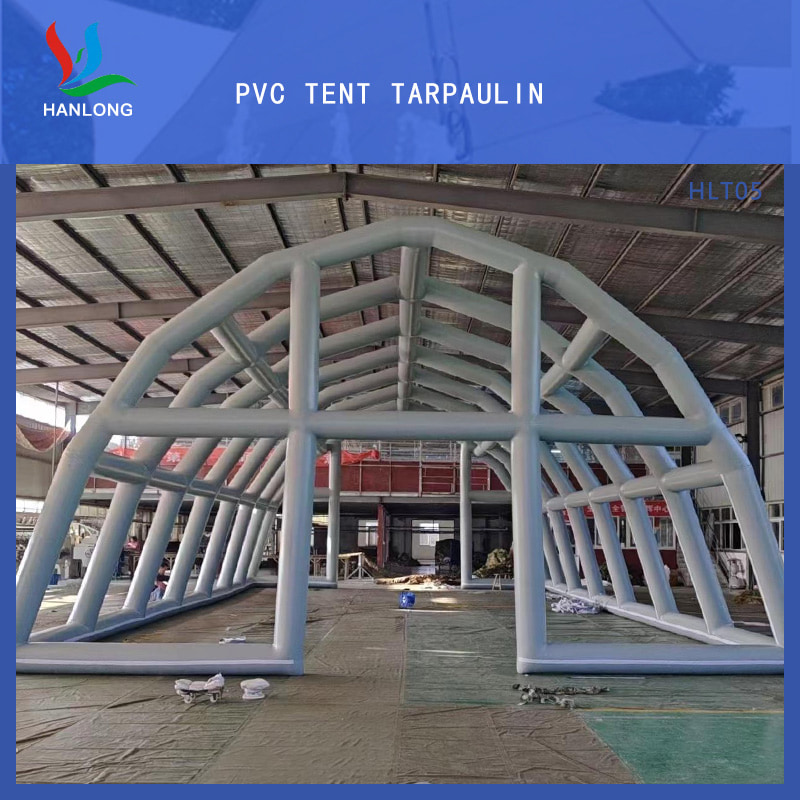 Custom 500X500D 28X28 610G 0.5MM PVC Tent Tarpaulin Fabric Suppliers, Company -ZheJiang Hanlong New Material Co.,Ltd is China 500X500D 28X28 610G 0.5MM PVC Tent Tarpaulin Fabric suppliers and OEM company, Item HLT0...View Product →
Visual Quality, Color, and Roll Consistency
Visual quality directly affects yield in your downstream production. Inconsistent color, surface pinholing, coating streaks, and die lines all force you to stop production and reject material. Before approving a bulk order, request a production-sized sample or a representative cutting from the final roll, and check for the following:
- Color difference across the roll width and between batches
- Visible pinholing or fish eyes on the coating surface
- Uniformity of gloss and surface texture
- Coating strike-through or uncovered areas on the reverse side
- Consistent roll winding without wrinkles or telescoping
Batch-to-batch color consistency is a common problem when suppliers change pigment suppliers or adjust the formulation. If your tent products are produced over several seasons, even a small color shift can create assembly problems between panels. A supplier that keeps a controlled pigment formulation and documents batch colors is safer to work with. If you are evaluating multiple suppliers for the first time, a practical framework for judging coated tarpaulin quality offers a step-by-step inspection approach beyond visual appearance.
Customization and the OEM Development Process
A true OEM relationship is not limited to choosing a standard fabric from a catalog. Development work often starts with a performance requirement or a target price point, and the factory translates that into a specification. A typical development process looks like this:
- You provide target performance, application, and design constraints
- The factory proposes a base cloth and coating formulation
- Pre-production samples are produced and shipped for evaluation
- The samples are tested on your equipment and in your environment
- Adjustments are made to weight, additives, finish, or color
- Final samples are approved and bulk production begins
This process is much more effective when you can visit the factory or at least hold video calls with the technical team. Ask about the product development team, not just the sales representative. Factories that maintain their own weaving and coating facilities can react faster to specification changes because the entire production chain is under one roof.
Customization can also mean adapting the surface finish to your brand. For special orders such as military shelters or premium camping tents, 1050 gsm camouflage PVC tent fabric for severe outdoor exposure is an example of a heavy-duty grade developed specifically for demanding end users.
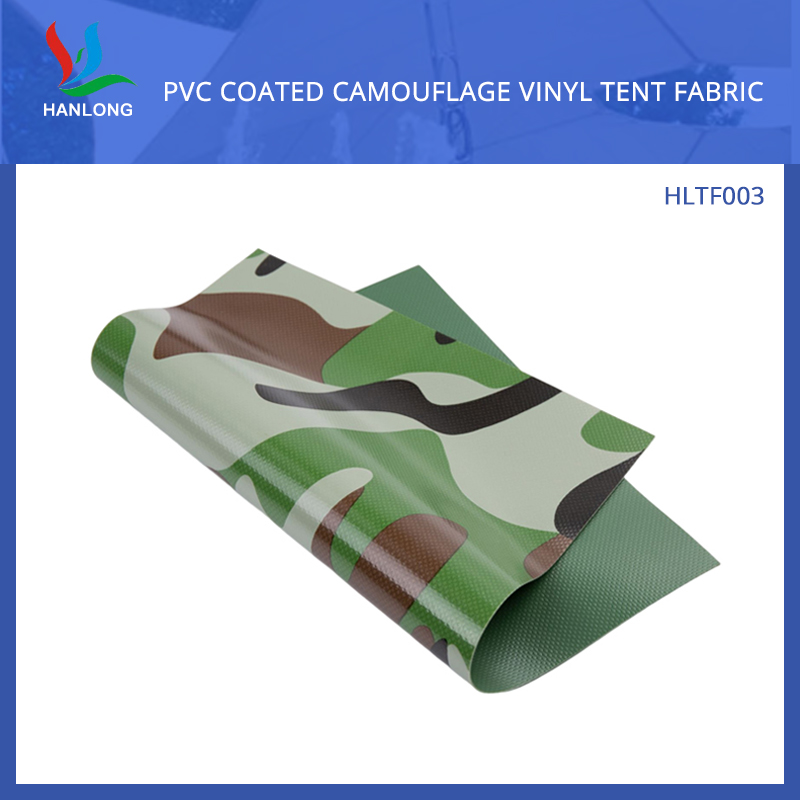 Custom PVC Coated Camouflage Vinyl Tent fabric 1300DX1300D 20X20 1050GSM SuppliZheJiang Hanlong New Material Co.,Ltd is China PVC Coated Camouflage Vinyl Tent fabric 1300DX1300D 20X20 1050GSM suppliers and OEM compa...View Product →
When verifying weather resistance before committing to a custom formulation, review the interaction between tent fabric construction and weather resistance to align your test expectations with your intended climate.
Qualifying a Manufacturing Partner: What to Verify
Your best insurance is not a sample; it is the capability and control system of the factory itself. Ask direct questions about the sourcing of base cloth, the coating line, and the quality control process.
First, confirm whether the factory produces its own base cloth or buys it from a third party. Owning the weaving process gives a factory more flexibility in adjusting yarn, density, and width to suit your application. It also reduces the risk that the base cloth supplier changes silently between batches.
Second, verify the coating or lamination capability. The presence of an in-house coating line means the factory controls the most critical process step. When a factory outsources coating, quality control becomes a two-vendor problem regardless of what a single sales team claims.
Third, review the quality control procedure. Reliable factories monitor gsm across roll width, perform incoming base cloth checks, and retain production records. They also document batch traces, so if an issue is found later, they can identify the affected rolls and the source of the problem.
At Hanlong, we operate our own weaving and processing facilities, with a factory area of 8,000 square meters and an annual output of approximately 9,070,000 square meters across the product range. Our technical and R&D team of more than 50 people supports specification development and quality monitoring throughout the production process. This internal capability is why we can control base cloth construction, coating formulation, and finished fabric consistency under one management system.
Final Steps: From Specification to Field Performance
OEM PVC coated tent fabric sourcing becomes manageable once you break it into clear decisions: define the base cloth and coating type, set realistic weight and tolerance expectations, confirm the additive package against your climate and fire requirements, test for adhesion and weldability, and verify the factory’s production control system. The time you invest in a complete specification sheet is the same time you save later in rework, rejected rolls, and long warranty disputes.
Use samples not only as a check of color and feel but as evidence of production capability. A supplier that can explain why each specification choice was made is far more valuable than one that simply ships a roll to match a price. When the base cloth, coating formulation, testing, and quality control are all aligned, the finished tent fabric will perform in the field the way it performed in the sample.



 Home
