
Article Directory
- 1 What Actually Makes a PVC Coated Tent Fabric Manufacturer Reliable?
- 2 Five Practical Checks Before You Place an Order
- 3 Common Sourcing Mistakes That Lead to Bad Tent Fabric
- 4 How to Read a Tent Fabric Specification Sheet
- 5 Why Integrated Manufacturing Matters for Tent Fabric
- 6 How to Work With a Manufacturer for Custom Tent Fabric
- 7 The Bottom Line
Choosing a reliable PVC coated tent fabric manufacturer comes down to five checkable areas: integrated production, specification transparency, GSM consistency, functional durability, and sample accuracy. A supplier that weaves its own polyester base fabric and applies PVC coating under the same roof can react faster to quality issues than a trader who buys and resells rolls. Use the checks below to compare suppliers objectively before you commit to a production order.
What Actually Makes a PVC Coated Tent Fabric Manufacturer Reliable?
Reliability begins with production integration. When a manufacturer has its own weaving and processing facilities, it controls the base fabric quality, the coating formulation, and final inspection. This matters because tent fabric performance depends on the connection between the polyester scrim and the PVC coating—not just on the weight of the roll.
A credible supplier should publish clear specifications for each material: yarn denier, weave density, finished GSM, coating method, and functional treatment. A commercial tent fabric range should cover light 300D×500D materials for consumer shelters and heavy 1300D×1300D materials for long-term outdoor installation. If a supplier can only offer “tent cloth” without specifying these values, you will be unable to compare products or judge whether the material suits your climate and wind load.
A capable manufacturer should also explain what happens during coating or lamination. For many tent structures, a PVC laminated fabric offers better peel strength and dimensional stability, while a coated fabric gives a softer hand and different welding behavior. The right choice depends on the tent frame, welding method, and expected service life. You can also browse the complete PVC coated tent fabric product collection to see how professional suppliers present their specs.
Five Practical Checks Before You Place an Order
These checks cover the most common causes of quality disputes in tent fabric sourcing. Work through them one by one, and you will have a much clearer picture of any manufacturer’s capability.
1. Verify the Base Fabric and Yarn Count
The yarn count determines the base strength of the tent. A 500D×500D fabric with a 28×28 density is sufficient for a medium frame tent, while a 1000D×1000D fabric with a 23×23 density gives much higher tear resistance and handles stronger wind loads. Ask the manufacturer for the exact denier and thread count before discussing weight. To give you a reference point, a 1000D×1000D 20×20 610g/650g PVC tent tarpaulin is a common starting point for medium-duty frame tents. If the supplier cannot state the yarn specification, it does not have control over its raw materials.
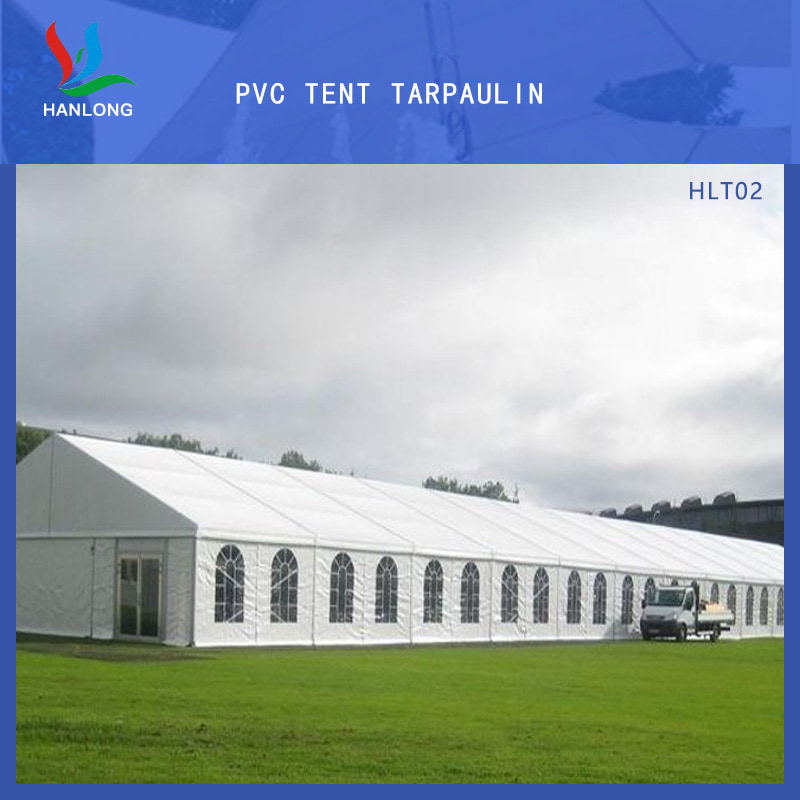 Custom 1000D 20X20 610G 650G PVC Tent Tarpaulin Suppliers, Company - ZheJiang HaZheJiang Hanlong New Material Co.,Ltd is China 1000D 20X20 610G 650G PVC Tent Tarpaulin suppliers and OEM company, Item HLT02 Weight (GS...View Product →
2. Confirm GSM Consistency and Tolerance
GSM, or grams per square meter, is the first number buyers compare, but consistency between rolls is more important than the number itself. A reliable manufacturer will measure each production batch and should be able to tell you its accepted tolerance. You can request samples from different production runs and weigh cut pieces yourself. Uniform weight means stable extrusion and coating processes. When the roof panel needs to be stiffer, a 1000D×1000D 23×23 850g/750g tent fabric delivers the additional grammage and a denser weave for large marquees.
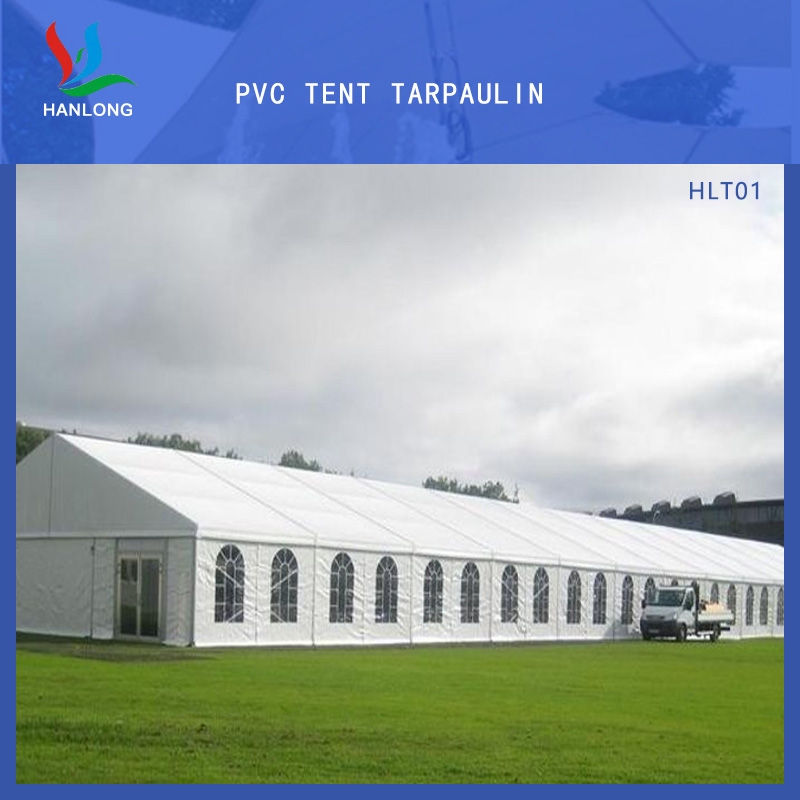 Custom 1000D 23X23 850G 750G PVC Tent Tarpaulin Suppliers, Company - ZheJiang HaZheJiang Hanlong New Material Co.,Ltd is China 1000D 23X23 850G 750G PVC Tent Tarpaulin suppliers and OEM company, Item HLT01 Weight (GS...View Product →
3. Evaluate UV Resistance and Flame Retardant Performance
Tent fabric must survive months of outdoor exposure. UV stabilizers slow down plasticizer migration and color fading that make PVC brittle. Flame retardant treatment is a separate consideration, and the standard varies by market and final use. Ask for actual test data and verify which additive system was used. For long-term military or high-abrasion applications, a 1300D×1300D PVC coated camouflage tent fabric is a proven choice because the heavier base scrim and dense coating delay UV degradation and mechanical wear.
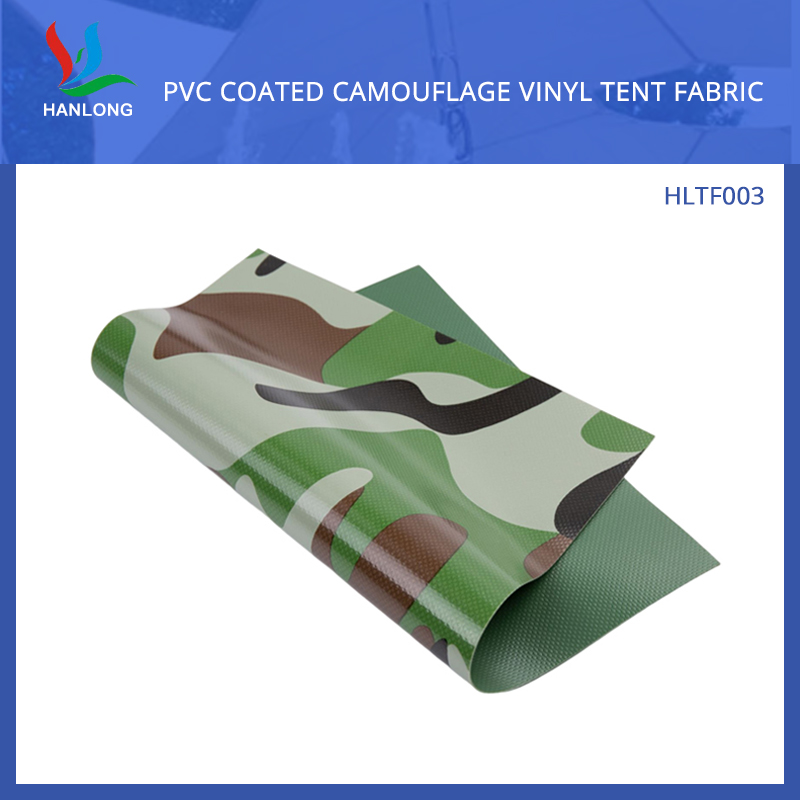 Custom PVC Coated Camouflage Vinyl Tent fabric 1300DX1300D 20X20 1050GSM SuppliZheJiang Hanlong New Material Co.,Ltd is China PVC Coated Camouflage Vinyl Tent fabric 1300DX1300D 20X20 1050GSM suppliers and OEM compa...View Product →
4. Understand Coating vs. Lamination
Some tent fabrics are coated directly onto the polyester scrim; others are laminated with a PVC film. Coated materials usually offer better cold flexibility, while laminated materials often have better weld strength and air tightness. The process depends on whether you are making sidewalls, inflatable structures, or large marquee roofs. A manufacturer that can explain the trade-off is more useful than one that only pushes a single production line.
5. Inspect Samples and Confirm Scale-Up Behavior
A beautiful hand sample means little if the production batch cannot replicate it. Ask how the manufacturer manages batch traceability and whether it keeps retained samples from every production run. A reliable supplier will also be honest about lead times and will not promise custom recipes without testing them on its own coating line.
Common Sourcing Mistakes That Lead to Bad Tent Fabric
Most tent fabric problems come from buying decisions that ignore engineering basics. Avoid these mistakes even when the price looks attractive.
- Choosing price over specification. A lower price often means a lighter polyester scrim or a lower-grade plasticizer that fails after one season of UV exposure.
- Ignoring the difference between 500D and 1000D fabrics. They look similar in a sample book but behave very differently under wind load and at welded seams.
- Assuming all flame retardant fabrics perform the same. FR additives can reduce cold flexibility; you need the right balance for your climate.
- Skipping the GSM consistency check. A roll that varies from the nominal weight can make seams shrink and awnings sag unevenly.
- Forgetting to specify the welding method. High-frequency welding, hot air welding, and glue joining all require a different surface finish.
To avoid these mistakes, study the manufacturer’s complete guide to judging PVC coated tarpaulin quality and compare it with your own inspection plan.
How to Read a Tent Fabric Specification Sheet
A professional specification sheet should give you yarn count, weave density, finished GSM, coating method, flame retardant status, UV rating, and roll width. The table below shows typical specifications for commercial tent fabrics.
| Yarn count | Weave density | Weight | Typical use |
|---|---|---|---|
| 500D × 500D | 28 × 28 | 610 gsm | Frame tents, sidewalls, camping shelters |
| 1000D × 1000D | 20 × 20 | 610–650 gsm | Medium-duty tents, party tents, awnings |
| 1000D × 1000D | 23 × 23 | 750–850 gsm | Large marquees, heavy-duty frame tents |
| 1300D × 1300D | 20 × 20 | 1050 gsm | Extreme weather shelters, military or industrial tents |
Once you understand the numbers, you can judge whether a manufacturer’s suggestions match your tent design and expected conditions. A reliable supplier should be able to recommend a starting specification based on your application and then adjust it during trial production.
Why Integrated Manufacturing Matters for Tent Fabric
Integrated manufacturing means the supplier controls the polyester weaving, the PVC coating or lamination, and the final inspection. For tent fabric, this is important because defects such as broken warp yarns, uneven coating, or poor adhesion are easier to trace when all steps happen in one factory. A trading company can only pass the problem back to its own supplier, which adds weeks to the correction cycle.
An integrated factory also has more flexibility for custom development. If you need a different yarn count, a higher GSM, an extra UV package, or a special color, the manufacturer can change the recipe on its own line and test it quickly. In our own operation, we combine a weaving plant, a processing plant, and an international trade department under one management system. With an annual output of around 9 million square meters of coated fabric, we can support both standard series and customer-specific developments. This kind of capacity is what you should look for when the order volume is large or the specification is demanding.
How to Work With a Manufacturer for Custom Tent Fabric
The quality of the final tent depends on the briefing you give the material supplier. Start by defining the end use and performance requirements, then move to technical parameters.
Define the use case and standards first
Tell the manufacturer whether the tent will be a temporary party tent, a semi-permanent warehouse, a military shelter, or an inflatable structure. Each use case has different requirements for wind load, fire resistance, and water column pressure. Also specify the regional standard you need to meet, such as EN 13501-1 for fire performance or ASTM for tensile strength. The manufacturer can then recommend a suitable fabric family rather than guessing.
Request a technical datasheet and test samples
Ask for the datasheet before the sample, and compare the datasheet with the physical sample. Check the feel, weight, and weldability. If possible, weld a few seams and test them by hand. A good supplier will not hide the test methods from you.
Set quality checkpoints for production
Agree on the key quality checkpoints: incoming yarn, coating weight, final inspection, and roll packaging. The manufacturer should be willing to send photos or inspection records at each stage. For large orders, you may also want a third-party inspection before shipment.
The Bottom Line
Choosing a reliable PVC coated tent fabric manufacturer is not a matter of luck. Check the supplier’s production integration, ask for exact yarn and GSM specifications, verify UV and flame retardant data, and confirm that samples match production. A manufacturer that can answer these questions with data and process control is far more likely to deliver a tent fabric that performs as promised. Start with a clear specification, request samples from different batches, and build a quality plan together with your supplier. That is the most direct route to a dependable tent fabric supply chain.



 Home
