
Article Directory
A manufacturer sends you a swatch labelled “waterproof PVC tent fabric.” The coating looks even, the hand feel is solid, and the price is attractive. Then your own quick rain test shows pin-hole leaks along a fold line. This scenario is common because waterproofing is not a single property; it is a set of measured behaviours. In our work as a maker of PVC-coated polyester tent fabrics, we have seen that the fastest way to avoid this problem is to understand the test methods behind the label. The conclusion you can rely on: durable waterproof performance is defined by hydrostatic head, spray rating, and long-term aging results, not by a visual check of the coating.
Start with the Fabric Construction, Not Just the Coating
The first thing to establish is the base cloth. Most PVC tent fabrics are built from polyester filament yarns woven into a scrim, then coated or laminated with PVC. The base fabric determines tensile strength, tear resistance, and how much coating the material can carry. A dense base fabric also creates a better barrier: with a tightly woven construction, water has fewer direct paths through the yarn intersections. For this reason, weight and thread count are useful early indicators. For example, a 1000D×1000D 23×23 construction with 850 to 750 gsm weight is a common choice for large tents because it offers a dense, stable substrate for a thick waterproof coating. One strong example is a 1000D×1000D 23×23 850g PVC tent tarpaulin.
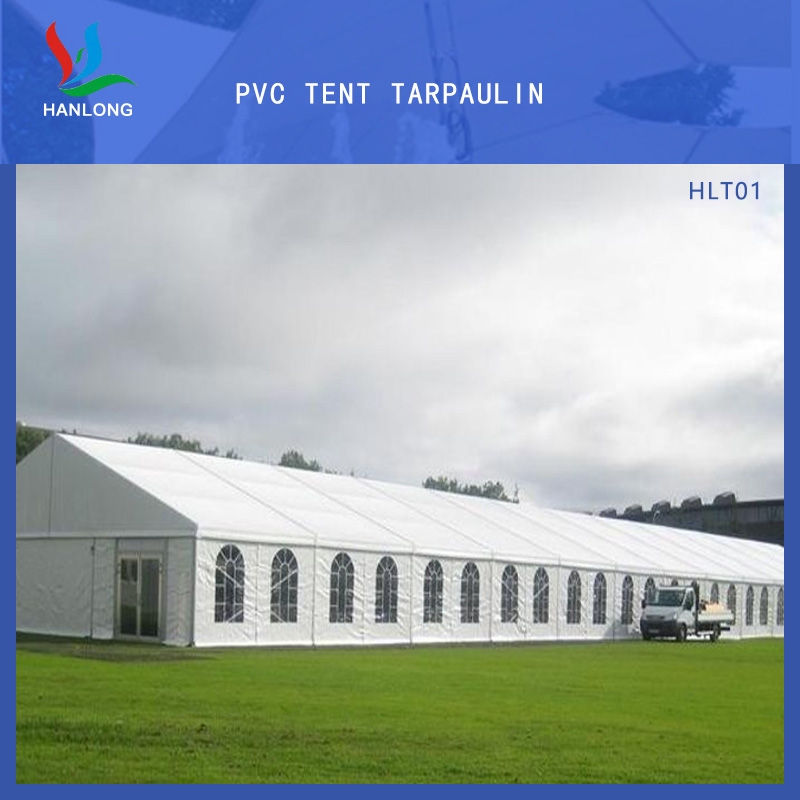 Custom 1000D 23X23 850G 750G PVC Tent Tarpaulin Suppliers, Company - ZheJiang HaZheJiang Hanlong New Material Co.,Ltd is China 1000D 23X23 850G 750G PVC Tent Tarpaulin suppliers and OEM company, Item HLT01 Weight (GS...View Product →
The coating is where the waterproof barrier actually forms. During knife coating or lamination, PVC layers fill the interstices of the weave and build a continuous film. If the coating is too thin, hydrostatic readings will be low. If the plasticizer formulation is wrong, the film will crack after UV exposure or in cold weather. So construction and formulation work together. With that in mind, the tests below are the ones that separate a weatherproof membrane from an ordinary coated tarp.
Hydrostatic Head: The Core Waterproof Test
The hydrostatic head test is the most direct measurement of a fabric’s resistance to water under pressure. A sample is clamped horizontally, and water pressure is applied from one side at a controlled rate. The test ends when a third drop of water penetrates to the other side. The result is expressed in millimetres of water column (mm H₂O) or in millibars. The most widely used procedures are ISO 811 and AATCC 127.
For coated tent fabrics, hydrostatic head values commonly range from 1,500 mm to more than 8,000 mm H₂O. A higher value means the fabric can withstand a taller column of water before leaking. In practice, though, the number has to be matched to the intended use. A light family tent with a 1,500 mm rating can handle normal rain, while a roof structure exposed to wind-driven rain needs a fabric well above 3,000 mm.
| Hydrostatic head range | Typical application |
|---|---|
| Below 1,000 mm H₂O | Light screening, dust covers, temporary shade |
| 1,000 – 2,000 mm H₂O | Lightweight camping tents in moderate weather |
| 2,000 – 5,000 mm H₂O | Family tents, event shelters, seasonal outdoor use |
| Above 5,000 mm H₂O | Expedition tents, semi-permanent structures, heavy wind-driven rain |
A high initial value is necessary but not sufficient. Once a fabric is folded, dragged across rough ground, exposed to UV, or flexed in cold temperatures, its hydrostatic head can fall sharply. That is why the next tests matter.
Spray Rating and Whole-Tent Rain Tests
Surface Spray Rating
Spray tests measure how easily water runs off the surface. In ISO 4920 or AATCC 22, a controlled volume of water is sprayed onto the sample at a fixed distance and angle. The wetted pattern is compared with a rating chart. A high spray rating means water beads and rolls off, which keeps the tent clean and reduces the load on the waterproof layer. A low rating does not necessarily mean the fabric leaks, but it tells you that the surface has become wettable, often because of plasticizer migration or contamination.
Whole-Tent Rain Simulation
Material-level tests do not see seams, zippers, or corner stress. For a tent, the finished product should also be set up and sprayed with a rainfall simulator for a set time, then checked for interior moisture. A fabric supplier can support this by providing consistent roll goods with predictable coating weights and by recommending correct seam welding or taping. In a product-level rain test, attention should be on fold lines and joins, because those are the places where a coated fabric is most vulnerable.
Aging and Wear Tests: The Real Proof of Waterproof Durability
Heat, UV and Weather Aging
Accelerated weathering tests in a QUV chamber expose fabric samples to alternating UV radiation and condensation at elevated temperature. The cycle simulates weeks of outdoor sunlight. After a defined exposure period, the sample is removed and tested again for hydrostatic head. A good tent fabric should retain most of its original value; heavy loss indicates poor UV stabilisation or coating embrittlement. When you look at a supplier’s test report, ask whether the data was measured on a fresh sample or after weathering. The difference is the difference between a marketing number and a performance number. This is especially important because UV resistance directly affects the overall performance and longevity of tent fabric.
Abrasion, Flexing and Tear Resistance
Abrasion can wear through the coating long before the polyester yarn fails. Flexing tests, often combined with low temperature, reveal whether the PVC film will crack after repeated folding. Tear resistance is also critical for tent fabric because a tear creates an entry point for water, and fabric with low tear strength fails quickly in the field. For demanding applications, heavier constructions are chosen not only for strength but for the thicker coating that protects the fabric. A flame-retardant camouflage PVC tent fabric at 1,300D×1,300D, 20×20, 1,050 gsm is a good example: the heavy coating provides an extra layer of defence against abrasion and keeps the fabric watertight for a longer service life. That configuration is available as heavy-duty flame-retardant camouflage PVC tent fabric.
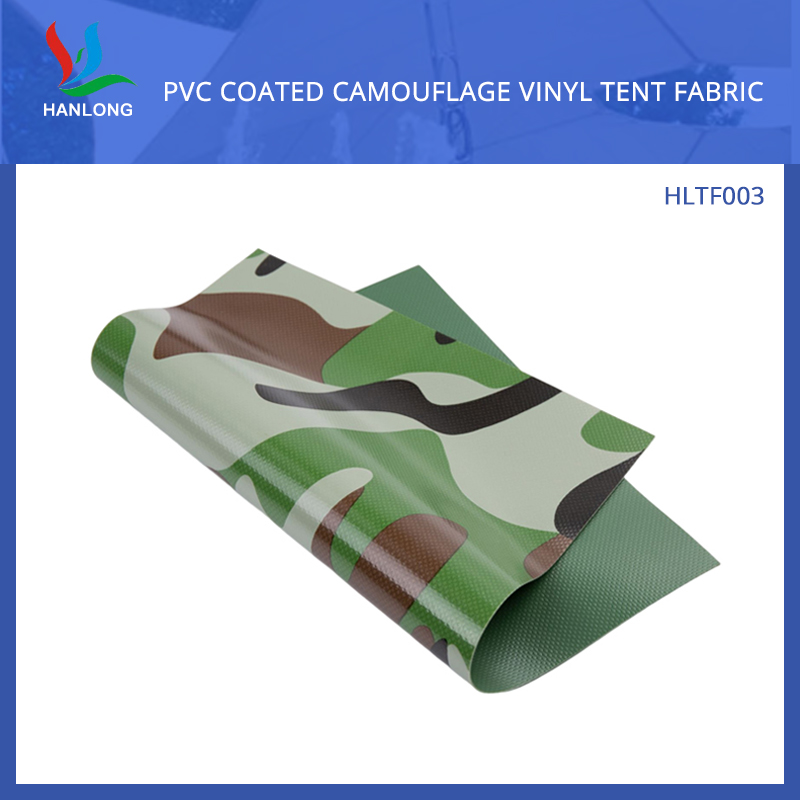 Custom PVC Coated Camouflage Vinyl Tent fabric 1300DX1300D 20X20 1050GSM SuppliZheJiang Hanlong New Material Co.,Ltd is China PVC Coated Camouflage Vinyl Tent fabric 1300DX1300D 20X20 1050GSM suppliers and OEM compa...View Product →
How to Read a Test Report Before You Order
A test report is only useful if you can connect it to your own product requirements. When reviewing a waterproofing claim, we recommend asking three questions.
- Which standard was used, and under what conditions was the sample prepared? Different standards can give different numbers, so you need to know the pressure rate, sample size, and conditioning before comparing results.
- Was the result measured before or after aging, abrasion, or flexing? Fresh sample data tends to look better; aging data reveals durability.
- How consistent is the result across production batches, and what is the GSM tolerance? Fabric weight variation changes coating thickness, and that changes waterproof performance.
Batch-to-batch consistency is especially important for tent factories. A material that measures 2,800 mm one week and 1,400 mm the next can create an unpredictable end product. This is why GSM consistency and tolerance in PVC tarpaulins deserve as much attention as the lab test itself.
A good balance between strength and handling comfort for many tent models is a 1000D×1000D 20×20 fabric at 610 to 650 gsm. It offers a substantial coating layer, reasonable flexibility, and consistent performance in conventional waterproof tests. For a manufacturer, asking for the test data behind this kind of fabric is the fastest way to validate a supplier. You can compare this specification against a 1000D×1000D 20×20 610-650g PVC tent tarpaulin when evaluating material options.
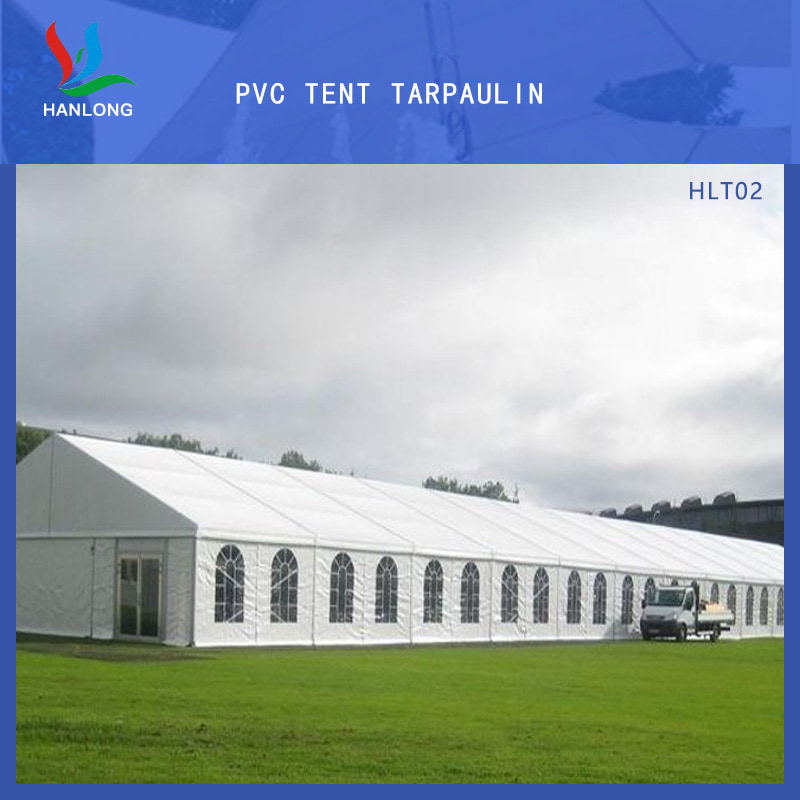 Custom 1000D 20X20 610G 650G PVC Tent Tarpaulin Suppliers, Company - ZheJiang HaZheJiang Hanlong New Material Co.,Ltd is China 1000D 20X20 610G 650G PVC Tent Tarpaulin suppliers and OEM company, Item HLT02 Weight (GS...View Product →
Conclusion
Waterproof performance for tent fabric cannot be confirmed by a single glance or a single number. The core test is hydrostatic head, but the long-term value is established through spray rating, weathering, abrasion, flexing, and batch consistency. When a supplier can explain what was tested, how it was tested, and how the numbers change after aging, you have the information needed to choose with confidence. That is the difference between a waterproof label and a waterproof fabric.



 Home
